Jill Gleeson's Blog
  • Home
  • Blog: As Above, So Below
  • Home
  • Blog: As Above, So Below

Gleeson reboots

Jill Went Up the Hill

5/2/2018

10 Comments

 
Picture
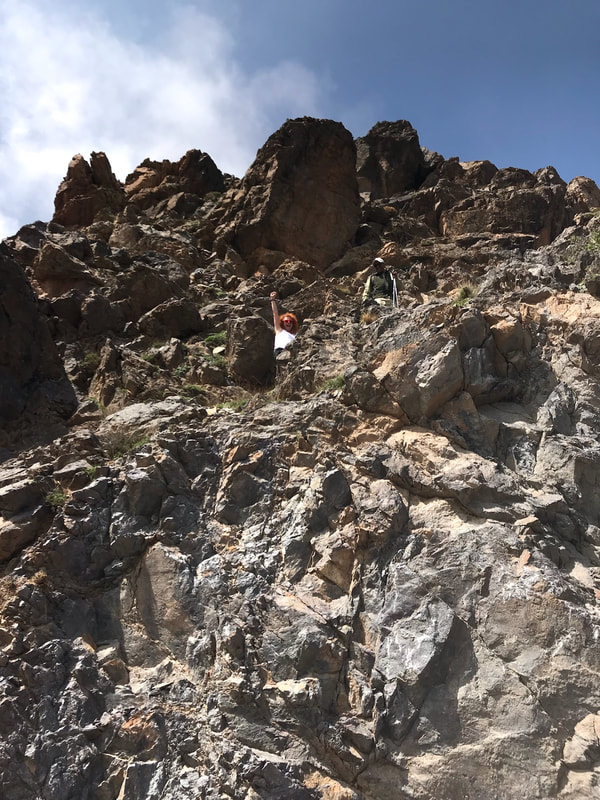
We went easy on our trek through the High Atlas. Slowly and carefully. I was climbing with someone who'd never done anything of the sort and it was enormously difficult for them, not the least because they were terrified of heights. I didn’t know that until we were well on the mule path, when we discovered how steep the drop from it was. Maybe we should have asked Ahmed, our guide, to take us back, but I was already gone, blissful and selfish. Stoned on the discovery that I still belong in the mountains. Or maybe it’s more that I belong to them.

The joy that I felt as the land fell away beside the path, opening up the view to the Berber villages thousands of feet below, was undistilled and overwhelming. It was almost impossible to rein myself in - I wanted to feel my heart thrum and my breath hasten and the muscles in my legs grow hard and unyielding as they struggled to carry me onward. I tried to slacken my pace, but I often found myself so far ahead of the others I had to stop and wait for them. I’d stiffen if I sat, so I remained standing, looking at Morocco spilling out beneath me.

It was my first time in the mountains since I failed to summit Aconcagua. I don’t know that I can count the slog up Little Malene in Greenland a couple weeks back, as difficult as it was. I never felt immersed in that landscape the way I did in the High Atlas range. We didn’t venture deep into the outback in frozen Greenland, though the climb was harder, with a sharper elevation gain. The ascent in Morocco was initially gradual. The toughest part for anyone with acrophobia, like the other trekker I was with, was the slender path, and the fear of the long fall if you stepped off of it.

Maybe I burned through any fear of falling at the beginning of the trek. I think the greatest concern anyone has for me - at least I’ve been told this, often with as much consternation as love - is that I’m reckless. That I take too many chances, don’t consider the consequences. I suppose it’s true; I’ve been trying to live a more careful life. I don’t know that I’m any good at it. Because after Ahmed gleefully scrambled a few feet up what was more a wall and less a hill, returning to earth dusting his hands with a grin, I challenged him to take me up it.

He told me it was dangerous, that the path up wasn’t even a mule trail. It was only for mountain goats and mountain guides, specifically those who had grown up in the High Atlas, like him. But I pushed and Ahmed eventually gave in and up we went. I was fine ascending, even as we climbed hand over feet, 10 feet, 20 feet, 30 feet and even higher. I think I was at one point four or five stories up, totally unsecured, with no one belaying me.

The precariousness of my situation didn’t hit me until we needed to start moving across the face of the incline. We left the path, which wound higher, and it made me feel every step was insecure. If I’d fallen I would have bounced until I hit the road that was far enough beneath me I’d have been killed, or at least badly broken. It crossed my mind that I could become a very sad and even more stupid cautionary story about a woman who pushed it too far once too often.

After I lost my nerve I spent some time sort of shuffling on my ass across the dirt, stone and scrub, until I felt more stable and could stand, a bit wobbly and ever so carefully, again. In another 10 minutes we'd picked our way off the hill, onto the road. We continued on, methodically trekking toward the Tizi Mzzik Pass, 3,000 feet higher and six miles away. I didn’t feel any elevation sickness along the way, although we eventually reached more than 8,000 feet in elevation. I’m not sure if I should be heartened by that, when it was acute mountain sickness that got me booted off Aconcagua. But I am. 

​I haven’t trained, not once, since coming down from Aconcagua in February, but I felt so strong during the trek. The last section was very steep, a merciless switchback that I climbed slowly, but without getting winded. My steps were sure and I worked my walking sticks well, in proper rhythm with my stride, even as we raced against the encroaching darkness to make it off the mountainside before full night fell. It felt right, my being up there, right the way it is when you fall in love, or the perfect song comes on as you’re driving fast down a back road in summertime, the sun bright and the wind soft. It felt, I suppose, like coming home.
10 Comments
Karen
5/4/2018 10:18:58 am

Love reading everything you do.

Reply
Sandra de Helen link
5/4/2018 11:37:08 am

I love keeping up with you via your blog. Your writing is excellent, and your escapades up my heart rate!

Reply
custom essay writer link
8/22/2018 09:33:11 am

Trekking isn't for everyone, especially if there is no expert to accompany you on this trip! But if you really want to experience it, you need to seek help for people who are doing it for years already! By the way, I can sense that your trek in High Atlas was a memorable experience for you! It may not be a perfect trip since it's too hot when you made there, but it still went well because you had fun. At the end of the day, what matters the most is you had fun.

Reply
Dissertation Writing Services link
4/8/2020 04:03:18 am

I also go to hill stations in Summer vacation and enjoy fully with my family.

Reply
Best Coursework Writing Service link
1/6/2022 03:31:32 am

We took it easy on our journey into the High Atlas. Slowly and cautiously. I was climbing with someone who had never done anything like this before, and it was quite tough for them.

Reply
Wallpaper Fixing Company in Dubai link
1/18/2022 03:59:07 pm

Handyman services Dubai is for you. The special thing that attracts you to gain our services that we do our services with your pocket range and

Reply
Vlone Shirts link
1/18/2022 03:59:57 pm

The Vlone Outfit carries a strong message behind it. It refers to “You live alone, you die alone”. It reflects your lifestyle. The way to express your feelings, thoughts, and ideas in terms of dressing.

Reply
San Diego Adult Classifieds link
5/19/2024 09:58:11 am

Goodd reading

Reply
Smith 123
4/16/2026 12:04:23 pm

<p><strong>RSCH FPX 7868 Assessment 3: Ensuring Ethical Data Collection in Qualitative Research</strong></p>
<p>Qualitative research plays a vital role in expanding knowledge in healthcare, education, and social sciences by exploring human experiences, perceptions, and behaviors in depth. Unlike quantitative research, which focuses on numerical measurement, qualitative research emphasizes understanding meanings and lived experiences. Because this approach often involves close interaction with participants and collection of personal narratives, ethical data collection is a central concern. Ensuring ethical practices in qualitative research protects participants’ rights, preserves trust <a href="https://nurs-fpx.net/">Nurs Fpx</a>, and strengthens the credibility of findings. Ethical data collection is not simply a procedural requirement; it is a moral obligation that guides every stage of the research process.</p>
<p>One of the foundational principles of ethical qualitative research is informed consent. Researchers must provide participants with clear, understandable information about the study’s purpose, methods, risks, benefits, and voluntary nature before collecting any data. Participants should know what they are agreeing to and have the freedom to decline participation without penalty. In qualitative studies, where interviews and observations may reveal deeply personal information, informed consent must be ongoing rather than a one-time event. Researchers should continuously check whether participants remain comfortable, especially if sensitive topics emerge during discussions. This process ensures that consent remains meaningful and respects participant autonomy.</p>
<p>Confidentiality is another essential ethical responsibility in qualitative data collection. Participants often share private thoughts, emotional experiences, and sensitive details that could expose them to social, emotional, or professional risks if disclosed. Researchers must protect participant identities by anonymizing data, using pseudonyms, and removing identifying details from transcripts and reports. Digital recordings, notes, and transcripts should be stored securely <a href="https://nurs-fpx.net/rsch-fpx-7868-assessment-1/">RSCH FPX 7868 Assessment 1 Developing a Research Question for Qualitative Studies</a>, with restricted access only to authorized personnel. Maintaining confidentiality not only protects individuals but also fosters openness, allowing participants to share honest and rich accounts without fear of exposure.</p>
<p>Closely related to confidentiality is the principle of privacy. In qualitative research, privacy refers to respecting personal boundaries regarding what participants choose to disclose. Researchers should avoid pressuring participants to answer uncomfortable questions or reveal more than they wish. Interviews should be conducted in safe, private settings where participants feel secure. Respecting privacy also means recognizing cultural norms and personal sensitivities that shape how individuals communicate experiences. Ethical researchers remain attentive to verbal and nonverbal cues indicating discomfort and adapt their methods accordingly.</p>
<p>Minimizing harm is a critical ethical principle that applies throughout qualitative data collection. Harm may be physical, emotional, psychological, social, or reputational. Because qualitative interviews can involve traumatic memories, illness experiences, or emotionally charged topics, researchers must be prepared to manage distress. This includes designing sensitive interview questions, allowing participants to pause or stop interviews, and providing referrals to counseling or support services when necessary. Researchers should weigh the value of knowledge gained against the potential burden placed on participants. Ethical data collection requires prioritizing participant well-being over research objectives.</p>
<p>Another important aspect of ethical qualitative research is cultural sensitivity and respect for diversity. Participants come from varied backgrounds with distinct beliefs, traditions, and communication styles. Researchers must approach each individual with cultural humility and awareness, avoiding assumptions or biases that may distort interpretation or create discomfort. Ethical data collection includes adapting language, consent procedures, and interview techniques to align with participants’ cultural contexts. This is especially important when working with marginalized or vulnerable populations, whose voices may already be underrepresented or misunderstood in research settings.</p>
<p>Special protections are required when conducting qualitative research with vulnerable populations such as children, older adults, individuals with cognitive impairments, prisoners, or economically disadvantaged group

Reply
Smith 123
4/23/2026 01:36:40 pm

<p>Qualitative research is a vital tool for understanding the intricacies of human experiences, behaviors, and social contexts, offering rich, descriptive insights through interviews, observations, and textual analysis. However, the depth and personal nature of this data also introduce complex ethical considerations that cannot be taken lightly. Ensuring ethical data collection is not merely a procedural requirement, but a foundational principle that safeguards participants' dignity, privacy <a href="https://nurs-fpx.net/">Nurs Fpx</a>, and autonomy while upholding the credibility of the research process.</p>
<p>A central concern in qualitative research is informed consent, which goes beyond simply obtaining a signature on a consent form. Researchers must communicate clearly and accessibly, ensuring that participants genuinely understand what they are agreeing to, and that their rights and boundaries are respected. This is particularly important in qualitative studies that may explore sensitive or deeply personal topics, where participants should feel empowered to withdraw from the study at any point without fear of penalty or judgment.</p>
<p>Respect for autonomy is another critical principle in qualitative research, where participants are not merely sources of data, but individuals with rights, values, and personal boundaries. Ethical researchers recognize this by allowing participants to control how much they share and by respecting their decisions throughout the research process. This respect fosters trust <a href="https://nurs-fpx.net/rsch-fpx-7868-assessment-1/">RSCH FPX 7868 Assessment 1 Developing a Research Question for Qualitative Studies</a>, which is essential for obtaining authentic and meaningful data.</p>
<p>Confidentiality and anonymity are also crucial ethical concerns in qualitative research. Researchers must take deliberate steps to protect participants by using pseudonyms, removing identifying details, and securely storing data. In some cases, complete anonymity may be difficult to achieve, and researchers must be transparent about these limitations and take additional precautions to minimize risks.</p>
<p>Minimizing harm is another cornerstone of ethical qualitative research, as qualitative studies often delve into personal experiences that may recall traumatic or distressing events. Researchers have a responsibility to anticipate these risks and implement strategies to mitigate them, such as providing participants with resources for counseling or support, carefully framing interview questions <a href="https://nurs-fpx.net/rsch-fpx-7868-assessment-2/">RSCH FPX 7868 Assessment 2 Developing a Qualitative Research Topic and Question</a>, and maintaining a sensitive and empathetic approach during data collection.</p>
<p>The concept of beneficence and justice also plays a crucial role in qualitative research. Beneficence requires researchers to maximize potential benefits while minimizing harm, while justice ensures that the burdens and benefits of research are distributed fairly. In qualitative research, this means avoiding the exploitation of marginalized or vulnerable populations and ensuring that participation is voluntary and that no group is unfairly targeted or excluded.</p>
<p>Researcher reflexivity is another often-overlooked aspect of ethical data collection, as qualitative researchers are deeply involved in the data collection process and their perspectives, biases, and interactions can influence the findings. Ethical practice requires ongoing self-awareness and critical reflection, where researchers examine how their own identities, beliefs, and assumptions shape the research process and take steps to minimize bias.</p>
<p>Challenges also arise in the representation and interpretation of data, where researchers must present findings in a way that remains faithful to participants' experiences. Misrepresentation, selective reporting, or taking statements out of context can distort the truth and harm participants. Ethical researchers strive for authenticity by including participants' voices through direct quotations and by acknowledging the complexity of their experiences.</p>
<p>In the digital age, ethical considerations in online qualitative research have become increasingly important <a href="https://nurs-fpx.net/rsch-fpx-7868-assessment-3/">RSCH FPX 7868 Assessment 3 Ensuring Ethical Data Collection in Qualitative Research</a>, with social media platforms, online forums, and virtual interviews providing new opportunities for data collection but also raising questions about privacy and consent. Researchers must carefully consider the expectations of privacy within online communities and obtain consent when appropriate, and ensure that digital data is stored securely and handled with the same level of care as traditional data.</p&

Reply


Leave a Reply.

    Jill Gleeson

    Jill Gleeson is a journalist based in the hills of western Pennsylvania. She is a current contributor to The Pioneer Woman, Country Living, Group Travel Leader, Select Traveler, Going on Faith, Wander With Wonder, Enchanted Living and State College Magazine, where her column, Rebooted, is featured monthly.  Other clients have included
    Woman's Day, Gothamist, Washingtonian, EDGE Media Network, Canadian Traveller, Country and  Country Woman. 

    Email me! 

    Archives

    May 2018
    April 2018
    March 2018
    February 2018
    January 2018
    October 2017
    July 2017
    June 2017
    April 2017
    February 2017
    January 2017
    December 2016
    November 2016
    October 2016
    September 2016
    August 2016
    July 2016

    Categories

    All
    Aconcagua
    Adventure
    Before Pictures
    Family
    Fear
    Gratitude
    Healing
    Heartbreak
    Kilimanjaro
    Loss
    Mountain Climbing
    Radio
    Screwing Up
    Sex
    Success
    Training
    Weight

    RSS Feed

      Join the Journey

    Snag Our Newsletter
Proudly powered by Weebly